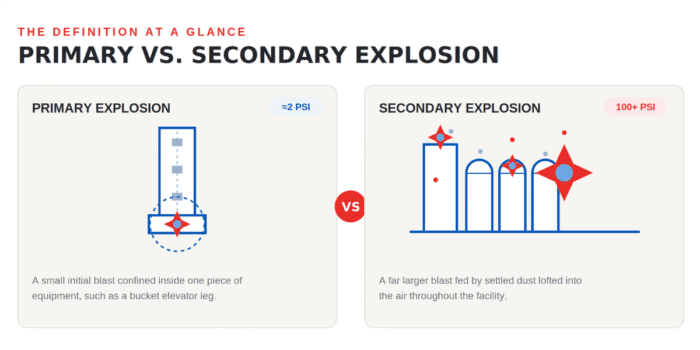
When people picture a grain elevator explosion, they imagine a single, massive blast. The reality is more dangerous: most catastrophic grain dust disasters end in a secondary dust explosion. A small first blast inside a piece of equipment sends out a shockwave that shakes loose the dust settled on floors, beams, and ledges throughout the building. A trailing flame ignites that fresh cloud, and the second explosion, far larger than the first, tears through the entire structure.
That second blast is the one that levels buildings and takes lives. Below, we break down how it forms, the real-world cases that reshaped the industry, and the housekeeping that prevents it.
A secondary dust explosion is a second, usually larger explosion that follows an initial “primary” blast. The primary explosion disturbs accumulated dust elsewhere in the facility, lofting it into a combustible cloud that then ignites.
Here is why this matters so much: the most severe consequences of dust explosions are usually caused not by the primary explosion, but by the secondary explosions that happen outside the initial piece of equipment. Historically, the majority of fatalities from dust explosions have been the result of secondary explosions, not the first blast.
In other words, good housekeeping is not about preventing every possible spark. It is about making sure that if a primary event occurs, there is not enough loose dust lying around to feed a building-wide chain reaction.
To understand the full set of conditions any dust explosion needs, see our guide to the dust explosion pentagon.
How a Secondary Explosion Forms: Step by Step
The sequence happens in a fraction of a second, but it unfolds in a clear, predictable order.
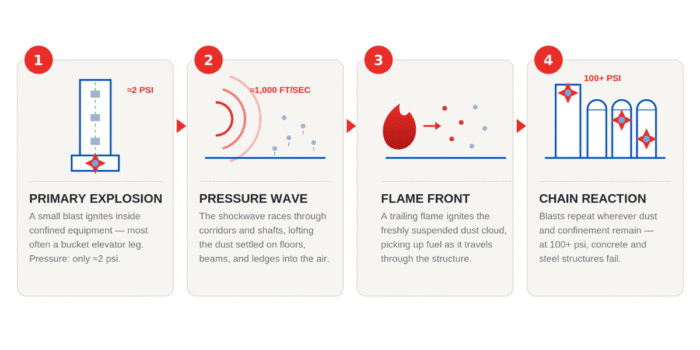
Step 1: The Primary Explosion
A small ignition occurs in a confined space, such as a bucket elevator leg, a duct, a dryer, or a grinder. On its own, this primary blast generates relatively modest pressure.
Step 2: The Pressure Wave Disturbs Settled Dust
The first explosion sends an air shockwave, or pressure front, traveling at roughly 1,000 feet per second along the gallery corridors, tunnels, and vertical shafts of the elevator. As it races through the building, this wave stirs up the dust that has settled on every horizontal surface.
Step 3: The Flame Front Ignites the New Cloud
A flame front follows close behind the pressure wave, moving at roughly 10 to 100 feet per second. It ignites the freshly suspended dust as it moves through the structure. Part of the dust from the original explosion is carried along with the wave, adding even more fuel.
Step 4: The Chain Reaction
Once initiated, a continuous series of explosions occurs for as long as there is adequate fuel (loose dust) and confinement. The result is a chain reaction of secondary explosions rolling through the facility wherever dust levels are high enough, causing the major structural damage.
Because the primary and secondary explosions are often only a split second apart, witnesses frequently describe hearing a single explosion or a rolling series of blasts, like thunder.
Why the Second Blast is So Destructive
The destructive gap between the two explosions comes down to pressure. And the numbers are dramatic.
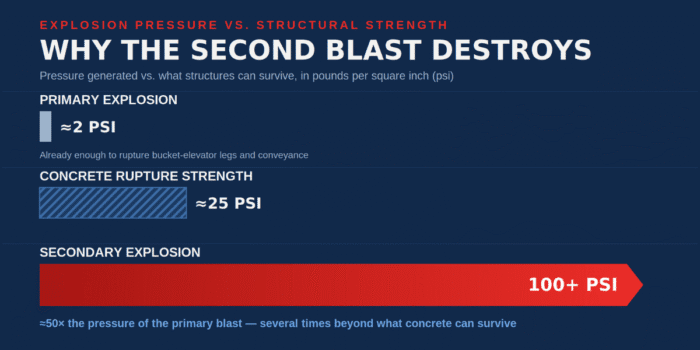
A primary explosion typically generates pressure of around 2 psi. A secondary explosion can generate pressure in excess of 100 psi, more than fifty times greater.
To put that in perspective, here is how those pressures compare to what the structures themselves can withstand:
At a Glance: Explosion Pressure vs. Structural Strength
Pressure Source
Approximate Pressure
What It Compares To
Primary explosion
~2 psi
Enough to rupture bucket elevator legs and conveyance (rupture strength ~2 psi)
Rupture strength of concrete
~25 psi
The point at which concrete structures fail
Secondary explosion
100+ psi
Several times beyond what concrete can survive
The takeaway is stark: a primary explosion is roughly strong enough to damage the equipment it starts in. A secondary explosion can exceed the failure point of concrete several times over, which is why these events collapse silos, topple headhouses, and destroy entire elevators.
Where Secondary Explosions Start in a Grain Facility
The primary explosion that triggers the chain reaction usually begins where grain is moving and dust is densest. Most grain dust explosions originate at grain transfer points, where the movement of grain releases dust at high concentrations and suspended particles collect in leg boots and elevator legs.
Common origin points include:
Bucket elevators (legs and boots): the most frequent starting point, where fast-moving grain generates both dust and friction.
Grinding and milling equipment: hammer mills and grinders create fine, highly combustible dust.
Grain dryers: heat plus dust is a direct ignition risk.
Dust collection systems and ducting: concentrated dust in a confined path.
Conveyors and transfer points: anywhere grain is dropped, moved, or handed off.
The danger is that even if the primary event stays contained to one of these areas, the dust lying on surrounding floors, beams, and rafters is what turns a localized problem into a facility-wide catastrophe. For the full picture of how these events develop, see our overview of silo fires and explosions.
Lessons From History
Two disasters shaped how the industry understands and regulates grain dust today.
Westwego, Louisiana (1977)
On December 22, 1977, a grain dust explosion tore through the Continental Grain elevator in Westwego, Louisiana, killing 36 people. It remains the deadliest disaster of its kind in modern history.
The blast destroyed several dozen silos, toppled a 25-story elevator, and sent a concrete tower crashing down onto an adjacent office building, trapping dozens of workers inside. Many of the victims were employees on their day off who had come in to pick up a Christmas turkey the company was giving as a gift; 25 of those who died had been in the office building when the blast hit.
The explosion was so powerful that it destroyed the very evidence investigators needed, and its official cause remains undetermined to this day. The scale of destruction, far beyond what a single primary blast could produce, is the signature of a secondary explosion chain reaction.
DeBruce, Wichita, Kansas (1998)
On June 8, 1998, a series of dust explosions ripped through the DeBruce Grain Elevator near Wichita, Kansas, killing seven workers and trapping ten others.
The casualty pattern tells the story of a chain reaction: deaths and injuries were spread across the west tunnel, the south array, the south gallery, the headhouse, and outside the east face of the building. The destruction traveled through the entire structure rather than staying in one spot. The elevator’s tall, vertical design created a “chimney effect” that let hot gases and dust rise through the building, worsening the spread.
The DeBruce disaster led to significant changes in U.S. agricultural safety practices and prompted the creation of OSHA’s Grain Elevator Explosion Investigation Team.
How to Prevent Secondary Explosions
Here is the encouraging part: secondary explosions are preventable. You cannot eliminate every possible ignition source, but you can remove the fuel that turns a small event into a deadly one. That fuel is settled dust.
In fact, one of the explicit goals of OSHA’s housekeeping requirements is to reduce the potential for secondary explosions.
The OSHA 1/8-Inch Rule
OSHA’s grain handling standard, 29 CFR 1910.272, sets a clear action level: a maximum dust accumulation of 1/8 inch in priority areas. Once accumulation reaches that depth, employers must begin removing it. OSHA recognizes that a 1/8-inch layer of dust is more than enough to fuel a fire or explosion.
Priority housekeeping areas are defined as:
Floor areas within 35 feet of inside bucket elevators
Floors of enclosed areas containing grinding equipment
Floors of enclosed areas containing grain dryers located inside the facility
Safe Housekeeping Practices
How you clean matters as much as how often, because careless cleaning can create the exact dust cloud you are trying to prevent.
Use gentle methods first. OSHA recommends vacuuming or sweeping with soft-bristle brooms to minimize the chance of layered dust being thrown back into the air during removal.
Control compressed air. Blowing dust down with compressed air is only permitted when all machinery presenting an ignition source is shut down and other known ignition sources are removed or controlled.
Have a written housekeeping program. The standard requires a written plan specifying the frequency and methods used to keep dust under control.
Inspection and Professional Cleaning
Regular inspection catches buildup before it becomes a hazard. Drone-assisted silo inspection can identify dust accumulation and buildup in tall, hard-to-reach structures, and professional silo and bin cleaning removes the fuel source safely without putting workers in harm’s way.
This is not a hypothetical or historical risk. According to tracking by Purdue University, there were seven grain dust explosions at U.S. agricultural facilities in a single recent year, a reminder that this remains an ongoing threat for grain handling operations.
What is the difference between a primary and secondary dust explosion?
A primary explosion is the initial, usually smaller blast that occurs inside a confined piece of equipment. A secondary explosion is the larger event that follows when the primary blast’s pressure wave lofts settled dust into the air and a flame front ignites it. Secondary explosions cause most of the structural damage and fatalities.
Why are secondary explosions more dangerous than the first?
Pressure. A primary explosion produces roughly 2 psi, while a secondary explosion can exceed 100 psi, well beyond the ~25 psi rupture strength of concrete. That is why secondary explosions collapse silos and destroy entire elevators.
How do you prevent a secondary dust explosion?
By removing the fuel: settled dust. OSHA’s grain handling standard requires action whenever dust accumulation reaches 1/8 inch in priority areas. Regular inspection, a written housekeeping program, and safe cleaning methods all reduce the loose dust that feeds a secondary blast.
What does the OSHA 1/8-inch rule mean?
OSHA’s 29 CFR 1910.272 standard requires facilities to begin removing dust once it accumulates to 1/8 inch in priority housekeeping areas, because that amount is enough to fuel an explosion.
Conclusion
The most important thing to understand about grain dust disasters is that the first explosion is rarely the one that does the damage. It is the second blast, fed by the dust already sitting in your facility, that destroys structures and costs lives.
That also means the solution is within your control. Secondary explosions need fuel, and that fuel is loose, settled dust. Disciplined housekeeping, regular inspection, and safe cleaning practices break the chain reaction before it can start.
At West Side Salvage, we have spent decades helping grain, food, and biofuel facilities across the U.S. manage dust hazards, from routine silo cleaning and inspection that prevents buildup, to emergency response when a disaster strikes. Every team member is Confined Space Certified and trained on the equipment and protocols these environments demand.
Want to get ahead of a dust hazard before it becomes an emergency? Contact us to schedule an inspection or request a cleaning quote.