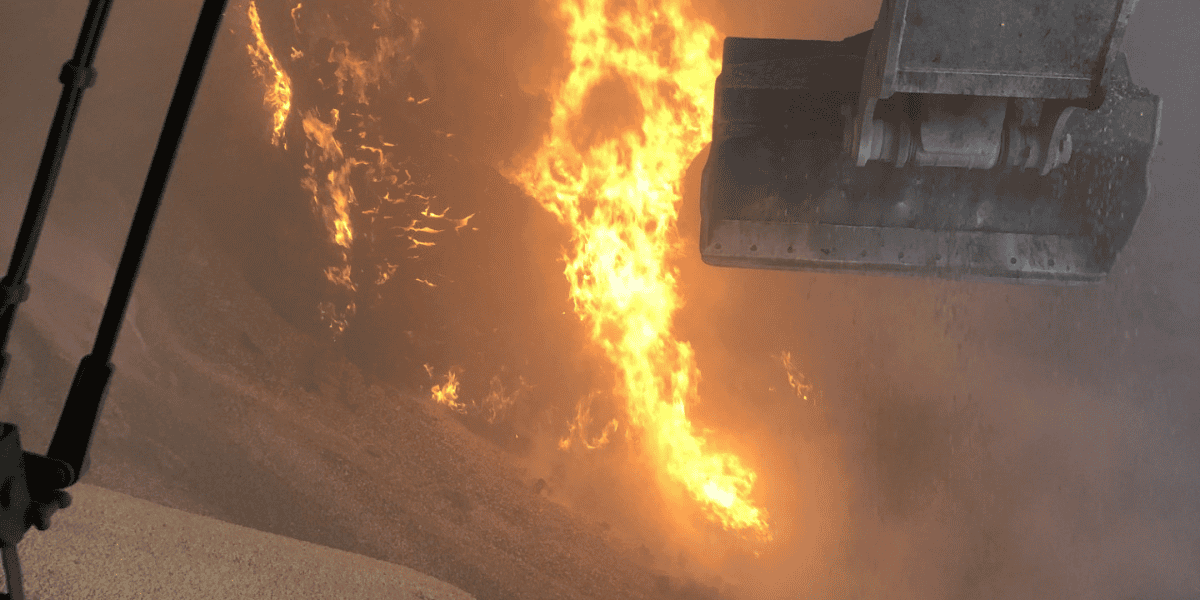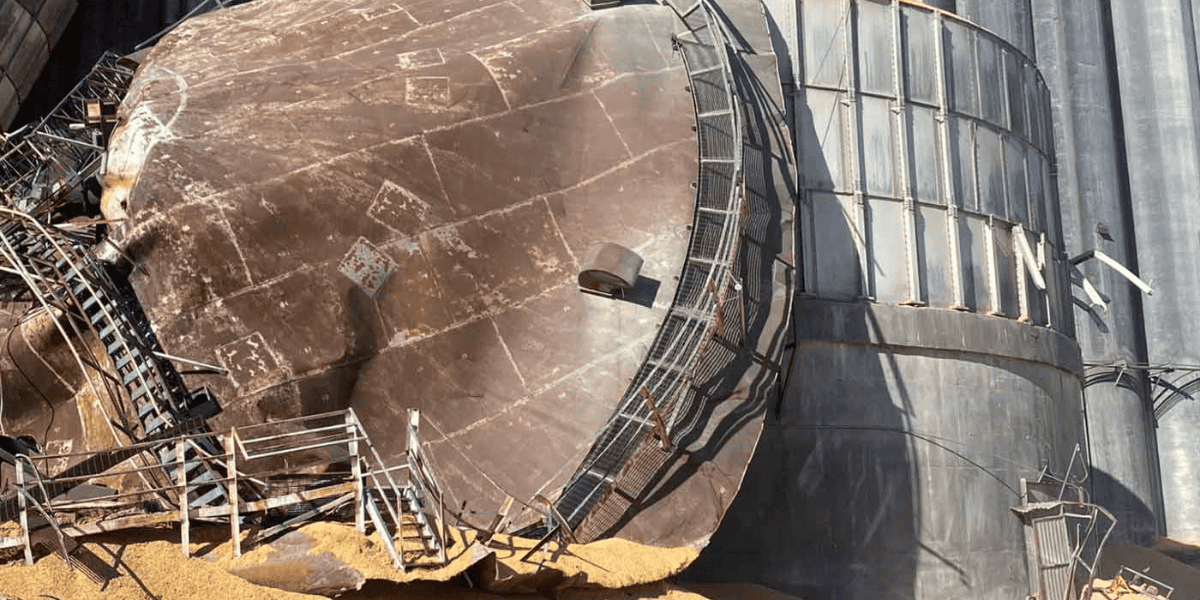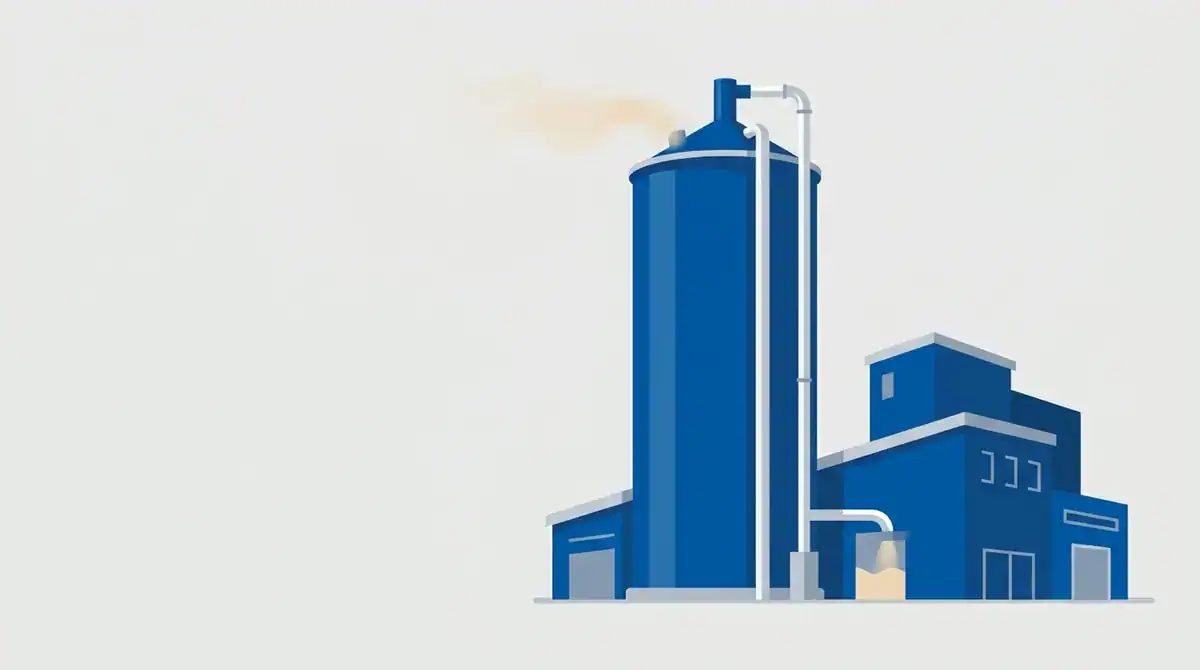
Flour looks harmless in a bag. Inside a silo, mill, or bakery, it can become one of the most dangerous materials in the building. When fine flour dust hangs in the air inside an enclosed space and meets a spark, it can burn so fast that it explodes.
Here is why that happens, where the risk builds, and how facilities keep it from happening.
Takeaways
- Flour is a combustible dust. A small amount suspended in air can explode if it finds an ignition source.
- Silos are high-risk because they combine all five explosion conditions: fuel, oxygen, ignition, a dust cloud, and confinement.
- Most ignition sources are everyday equipment problems: hot bearings, tramp metal, static, smoldering buildup, and hot work.
- The first blast is often not the worst. It can shake settled dust loose and fuel a larger second explosion.
- Prevention comes down to dust control: housekeeping, clean silos, ignition control, and a current dust hazard analysis.
Is Flour Explosive?
Yes. Flour is a combustible dust, and a cloud of flour dust can explode when it is ignited in an enclosed space. A bag of flour on a shelf will not explode. The danger comes when fine flour particles are suspended in air at a high enough concentration, inside something that traps the pressure, like a silo, bin, duct, or mill room.
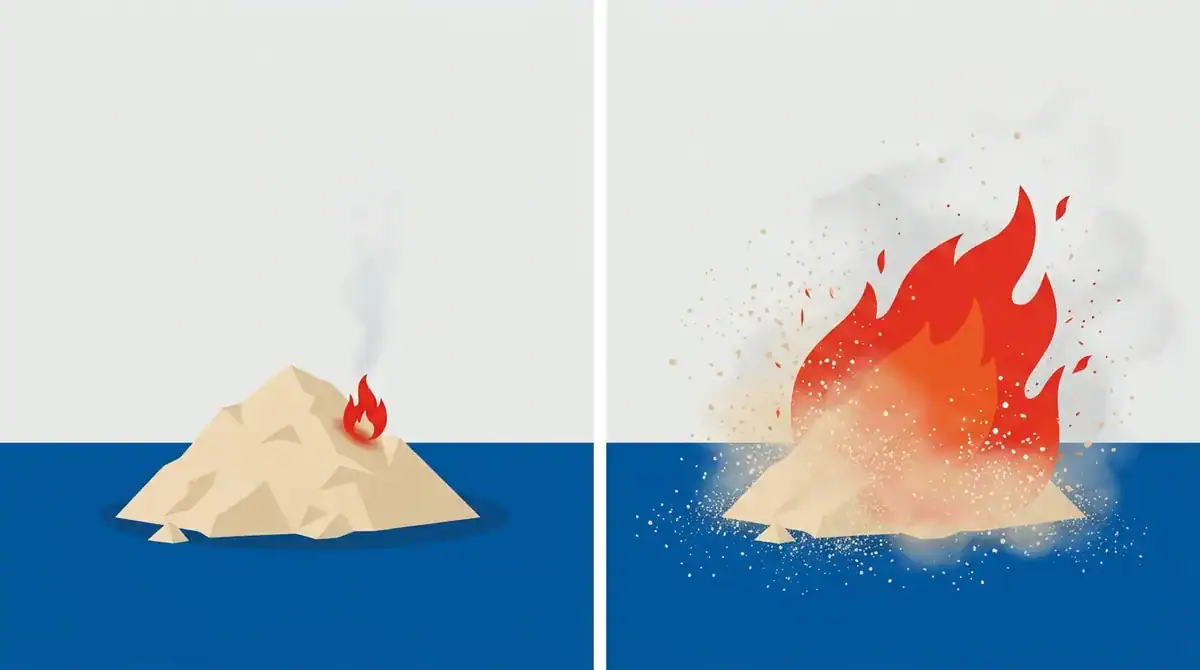
Flour burns slowly in a pile because only the surface touches oxygen. Spread into a cloud, each tiny particle is surrounded by air. The flame jumps from particle to particle almost instantly, and the rapid release of heat and gas is what creates the explosion.
Why Flour Silos Explode: The Five Conditions
A flour dust explosion needs five things at once. Safety professionals call these the five elements of a dust explosion. A flour silo can supply all five during normal operation.
| Condition | What it looks like in a flour silo |
|---|---|
| Fuel | Fine flour and flour dust, both inside the silo and settled on nearby surfaces |
| Oxygen | Normal air in the headspace and around conveying equipment |
| Ignition | A spark, hot surface, static discharge, or smoldering buildup |
| Dispersion | Flour falling during filling, being blown in by pneumatic conveying, or knocked loose from the walls |
| Confinement | The silo itself, plus connected ducts, elevators, and dust collectors |
Takeaway: Remove any one of the five and an explosion cannot happen. In practice, fuel (dust) and ignition are the two that facilities can control most.
The same five conditions are behind grain dust explosions as well. For fires that smolder inside stored product, see our guide to silo fires.
What Makes Flour Dust So Dangerous?
Three properties make flour a serious explosion hazard.
- Fine particle size. OSHA notes that how explosive a dust is depends on particle size, shape, and moisture. NFPA has defined combustible dust as particles 420 microns (0.42 mm) or smaller.
- It does not take much. The minimum explosible concentration (MEC) is the smallest amount of dust in the air that can explode. In lab testing for the U.S. Chemical Safety Board, a flour sample from Didion Milling had an MEC between 70 and 80 grams per cubic meter of air.
- Low ignition energy. The same flour sample ignited with 30 to 100 millijoules of energy. OSHA lists static electricity and mechanical sparks among the ignition sources facilities need to control.
| Test (flour sample, CSB Didion investigation) | Result |
|---|---|
| Minimum explosible concentration | 70 to 80 g/m³ |
| Minimum ignition energy | 30 to 100 mJ |
| Maximum explosion pressure | 8.1 bar (about 117 psi) |
| Dust explosion class | St-1 (explosible) |
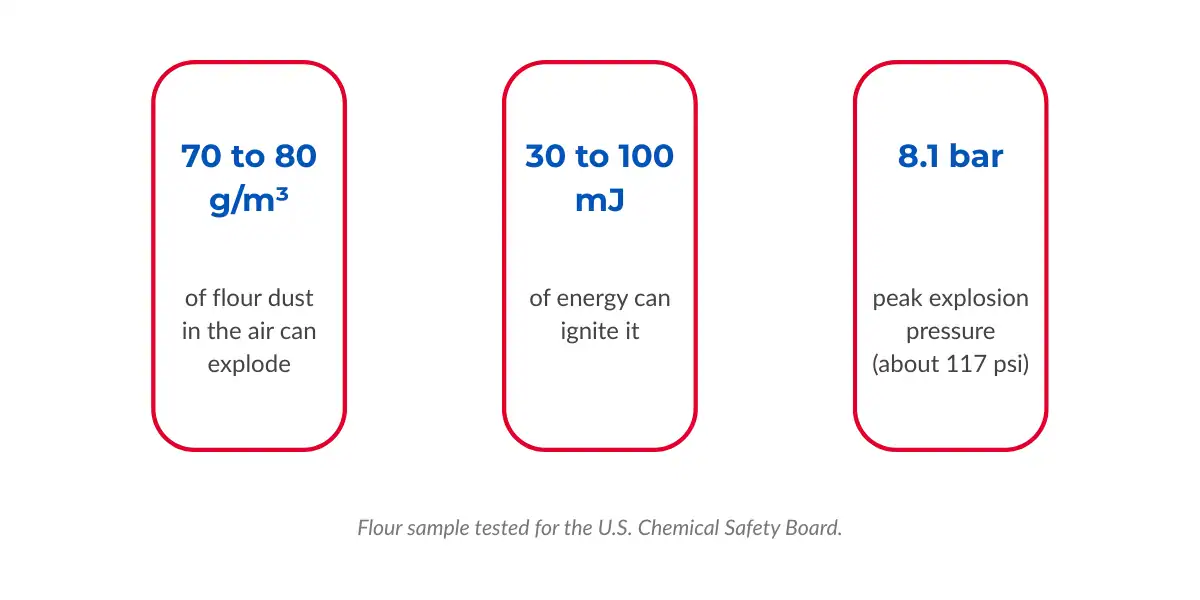
Takeaway: The testing lab notes these values are not fixed material properties. They change with the sample, particle size, moisture, and test method, so treat them as indicators, not exact limits.
Moisture matters too. OSHA lists moisture content as one of the factors that changes how explosive a dust is. The CSB samples were dried and finely sieved before testing, which reflects the highest-risk condition: dry, fine flour.
What Ignites Flour Dust?
Ignition sources in flour handling are usually equipment problems, not open flames.
- Overheated bearings and hot surfaces on bucket elevators, conveyors, and motors
- Tramp metal (bolts, wire, or other metal) entering grinders, hammer mills, or other equipment and striking a spark
- Static electricity built up during pneumatic conveying and silo filling, especially with ungrounded equipment
- Smoldering nests, pockets of hot or burning material inside equipment that can ignite a dust cloud later
- Hot work like welding, cutting, or grinding near dust
- Electrical equipment not rated for dusty locations
Where the Risk Builds in a Flour Facility
The highest-risk moments are when flour is moving and dust is in the air.
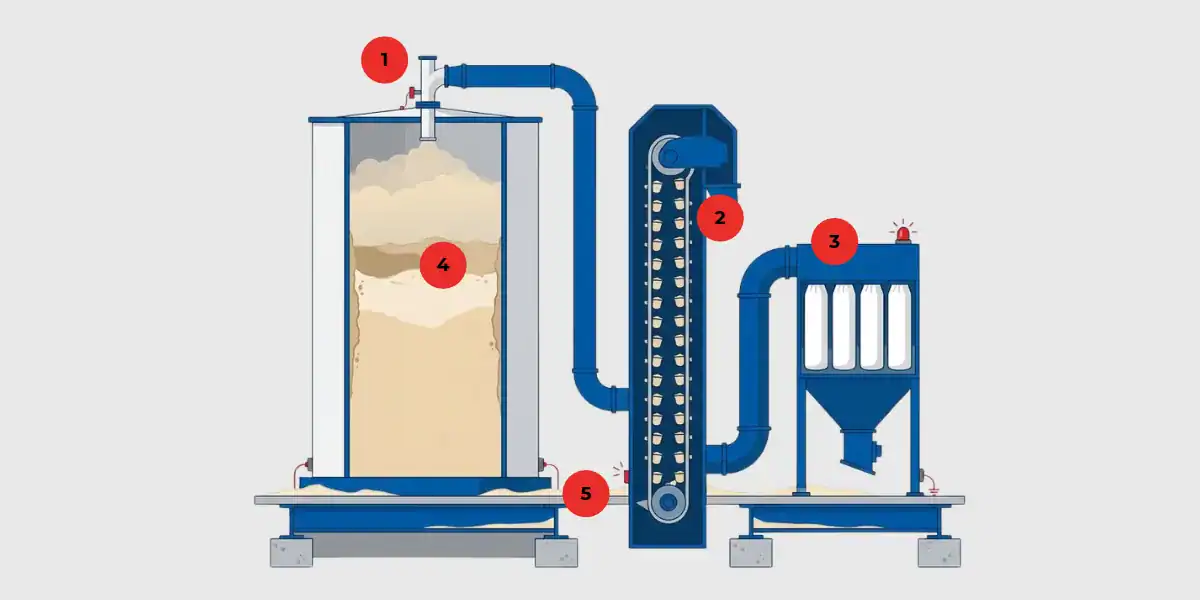
- Silo filling. Flour falling into the silo, or blown in by pneumatic conveying, creates a dust cloud in the headspace.
- Bucket elevators and conveyors. Moving parts, friction, and dust in a tight enclosure.
- Dust collectors. OSHA notes a combustible dust mixture can be present inside them whenever they are running. At Didion, fire spread through connected dust collection systems.
- Cleaning and unplugging. Knocking caked flour loose or breaking up flow problems like bridging and ratholing can put a lot of dust in the air at once.
- Settled dust outside the silo. Flour that leaks onto beams, ledges, and floors becomes fuel for a second blast.
The Second Blast Is Often Worse
A small first explosion can shake loose flour dust that has settled on surfaces throughout a building. That dust forms a much larger cloud, and the fire from the first blast ignites it. These secondary explosions are often what destroys buildings and causes the most injuries.
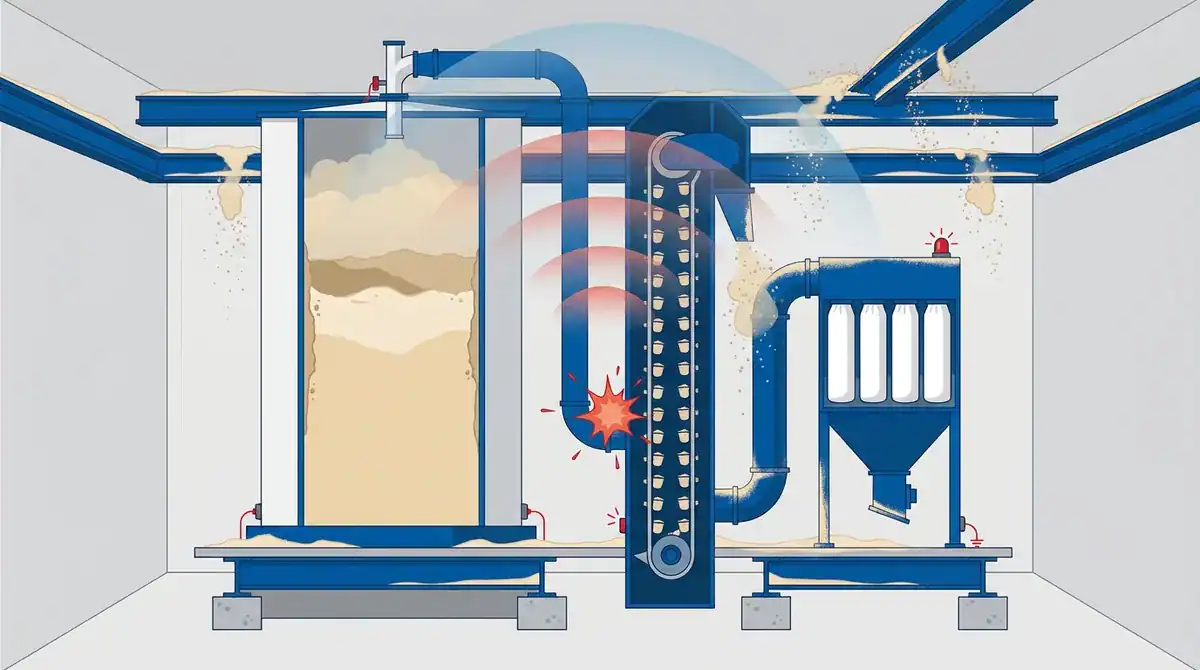
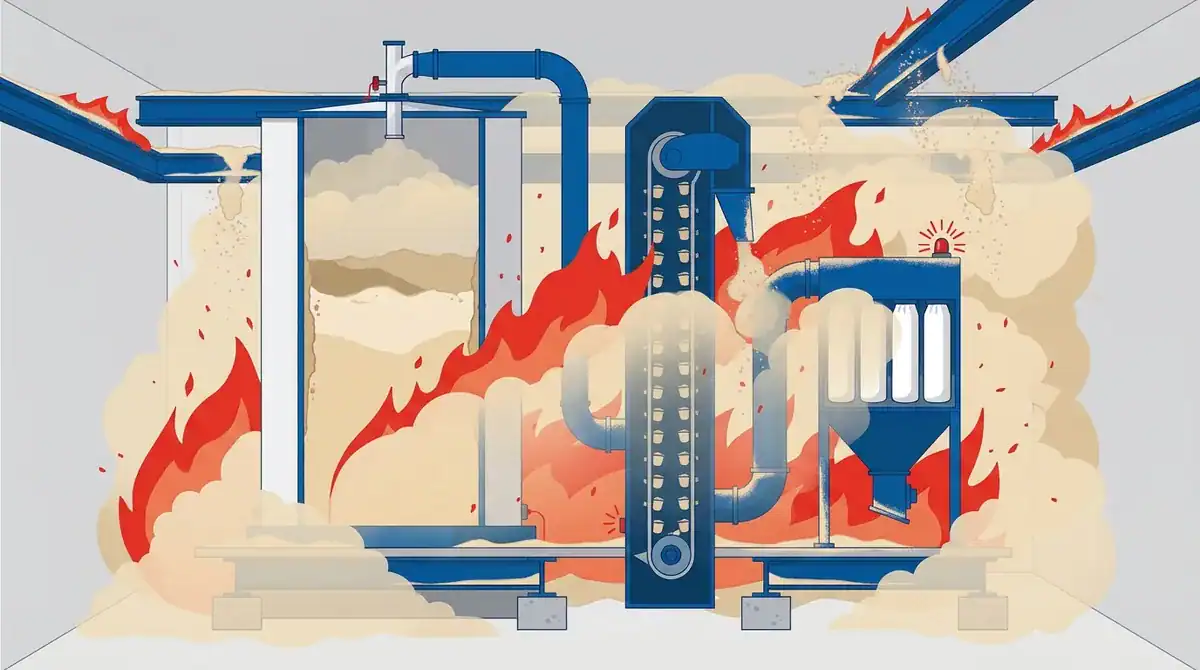
Takeaway: Housekeeping outside the silo matters as much as what happens inside it.
Real-World Flour Dust Explosions
| Incident | What happened | What changed |
|---|---|---|
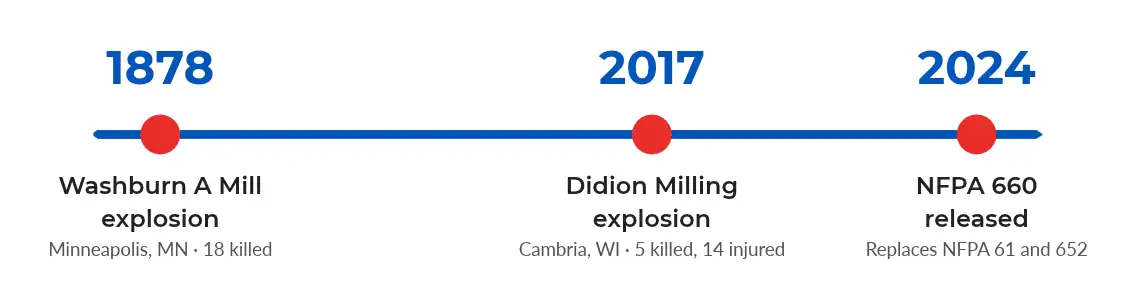
| Washburn A Mill, Minneapolis, Minnesota (May 2, 1878) | Two millstones running dry likely rubbed together and sparked, igniting airborne flour dust. The explosion killed 18 workers, leveled the mill, and destroyed much of the riverfront business area. The city lost one-third to one-half of its milling capacity. | The mill was rebuilt by 1880 as a safer, more advanced mill, and the disaster prompted major safety upgrades in later mill designs. |
| Didion Milling, Cambria, Wisconsin (May 2017) | A smoldering nest of dust inside the corn grinding process ignited, setting off an explosion inside milling equipment at this dry corn milling facility. Secondary explosions spread through the mill buildings. Five employees were killed and 14 were seriously injured. | The U.S. Chemical Safety Board called on OSHA to create a national combustible dust regulation and on NFPA to strengthen its dust hazard analysis requirements. |
OSHA found the Didion explosion likely resulted from failures to correct the leakage and buildup of combustible dust throughout the facility and to maintain equipment that controls ignition sources. Both incidents point to the same lesson: dust buildup plus an ignition source is a disaster waiting for a trigger.
How to Prevent Flour Silo Explosions
| Prevention step | What it involves |
|---|---|
| Control dust buildup | A written housekeeping program, regular removal of settled dust on floors, ledges, and equipment, and fixing leaks at the source |
| Keep silos clean | Scheduled cleaning to remove caked flour, buildup, and out-of-condition product before it becomes a hazard |
| Control ignition sources | Bearing temperature monitoring, magnets to remove tramp metal, grounding and bonding to prevent static, and hot work permits |
| Use dust collection | Properly designed and maintained dust collection systems at transfer points |
| Plan for the worst case | Explosion venting, suppression, and isolation so a blast in one piece of equipment cannot travel to the next |
| Do a dust hazard analysis (DHA) | A documented review of where combustible dust could ignite, kept current as processes change |
| Train employees | Make sure workers know flour dust is explosive and can spot buildup, hot equipment, and ignition risks |
OSHA recognizes that a 1/8 inch dust accumulation is more than enough to fuel a fire or explosion. Grain elevators must remove dust in priority areas once it passes that depth. Flour mills are not held to that exact number, but they must have a written housekeeping program to reduce dust buildup.
Free download: Walk your facility with our one-page Flour Silo Explosion Prevention Checklist (PDF). It covers every step above and flags which items OSHA requires for flour mills. Print it or fill it out on screen.
What Regulations Apply to Flour Dust?
- OSHA Grain Handling Facilities Standard (29 CFR 1910.272). It covers flour mills along with grain elevators, feed mills, and rice mills. For flour mills, it requires a written housekeeping program, annual training, hot work permits, preventive maintenance, and a way to remove metal from the grain stream.
- No federal combustible dust standard yet. OSHA began rulemaking in 2009 and set it aside in 2017. In February 2026, the Chemical Safety Board noted that OSHA has still not issued one.
- NFPA 660 replaced NFPA 61 and NFPA 652. In December 2024, the NFPA consolidated its combustible dust standards into NFPA 660, Standard for Combustible Dusts and Particulate Solids. Chapter 21 now covers agricultural and food processing facilities, the content formerly in NFPA 61. Facilities with a dust hazard analysis done under the older standards should confirm it lines up with NFPA 660.
Frequently Asked Questions
Can flour explode in a kitchen?
It is very unlikely in normal cooking. A flour explosion needs a dense dust cloud in an enclosed space plus an ignition source. Flour is combustible, though, and fire safety guidance warns never to use it on a grease fire.
Is flour more explosive than gunpowder?
No, they work differently. Gunpowder contains its own oxidizer and burns fast even in a pile. Flour only explodes when it is spread into a cloud in air, but under those conditions it can be destructive enough to level a building.
How much flour dust does it take to cause an explosion?
In lab testing for the Chemical Safety Board, a flour sample could explode at concentrations between 70 and 80 grams per cubic meter of air. Settled dust is also a hazard, because a first blast can lift it into a much larger cloud.
Why do flour mills explode?
Milling creates large amounts of fine dust and uses equipment with many ignition sources, like grinders, bearings, and conveyors. When dust leaks and builds up, one spark can set off an explosion that spreads through the building.
Does moisture prevent flour dust explosions?
Moisture lowers the risk but does not remove it. OSHA lists moisture content as one of the factors that affects how explosive a dust is. Dry, fine flour carries the highest risk.
What should you do if a flour silo catches fire or explodes?
Call 911 first. Keep everyone away from the silo, do not open or enter it, and shut down equipment only if it is safe to do so. Then call a specialized response team to handle removal of damaged or burning product.
Keep Your Flour Silos Clean and Safe
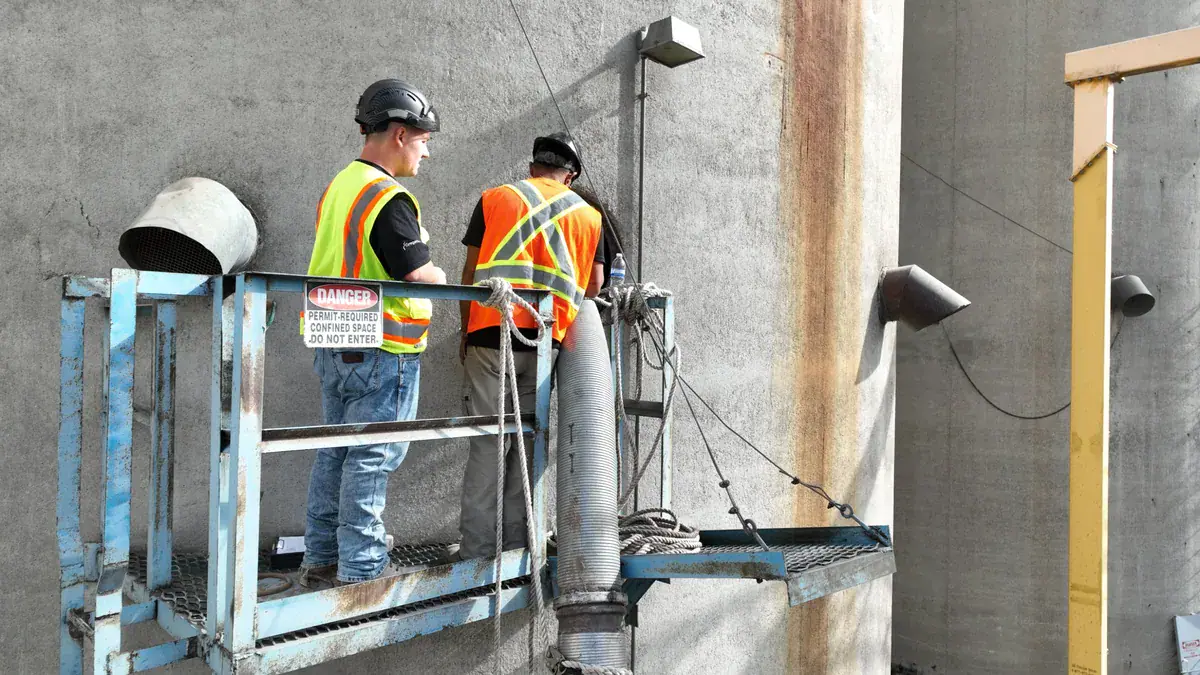
Regular cleaning is one of the simplest ways to cut down the fuel a flour dust explosion needs. West Side Salvage provides flour silo cleaning with confined space certified crews using bin whips, high-volume vacuums, and other specialized equipment. We unplug silos, remove out-of-condition flour, and build a cleaning schedule around your operation.
If something has already gone wrong, our emergency explosion response team is available 24/7. Based in the Midwest, our crews respond from the Rockies to the East Coast.
Not sure where your facility stands? Start with our free Flour Silo Explosion Prevention Checklist (PDF).
Call 844-246-2234 any time, or request a quote for scheduled flour silo cleaning.
Sources
- Minnesota Historical Society: Mill City Museum Building History
- Minnesota Historical Society (MNopedia): Washburn A Mill Explosion, 1878
- U.S. Chemical Safety Board: Final Investigation Report, Didion Milling
- U.S. Chemical Safety Board: Safety Video on the Didion Milling Explosions (Feb 2026)
- U.S. Chemical Safety Board: Didion Investigation, Appendix G, Dust Explosibility Testing Report
- U.S. Chemical Safety Board: Recommendation Status Change Summary, OSHA Combustible Dust Rulemaking
- Powder & Bulk Solids: New CSB Update on Didion Dust Explosion Investigation
- OSHA: Combustible Dust in Industry, Safety and Health Information Bulletin 07-31-2005
- OSHA: Grain Handling
- OSHA: 29 CFR 1910.272, Grain Handling Facilities
- Powder & Bulk Solids: A 10-Point Guide to the New NFPA 660 Standard
- University of South Florida Environmental Health & Safety: Cooking Safety